Thinking About Trying Touch for Health?
If you’ve been reading about Touch for Health or someone has recommended it to you, it’s natural to have questions.
Because Touch for Health isn’t as widely known as massage therapy or chiropractic care, many people wonder what actually happens during a session, what muscle monitoring means, and whether it’s the right approach for them.
Below are answers to the questions we hear most often.
If you’re completely new to Touch for Health, we recommend reading Could Your Body Be Holding Onto Stress Without You Realizing It? first. It explains how stress can affect the body and introduces the whole-person approach behind Touch for Health.
Quick Summary
Touch for Health is a gentle, non-invasive wellness approach that uses muscle monitoring, reflex techniques, acupressure, movement, and personalized goal setting to support the body’s natural ability to adapt to physical, emotional, and environmental stress.
Every session is individualized and focuses on helping you move toward your own health and wellness goals. Because every person is different, no two Touch for Health sessions are exactly alike. Your practitioner follows your body’s priorities and your personal wellness goals.
1. What Exactly Is Touch for Health?
Touch for Health is a gentle, non-invasive biofeedback system that helps identify where communication within the body may be under stress.
It combines muscle monitoring, reflex balancing, meridian theory, and personalized goal setting to help restore balance throughout the nervous system and the body’s natural energy pathways.
Rather than focusing on disease or symptoms alone, Touch for Health looks at how the whole person is functioning physically, emotionally, mentally, and energetically. The goal is to support your body’s natural ability to communicate, adapt, and function at its best.
If you’d like to learn more about the philosophy behind this approach, visit our What Is Touch for Health? page.
2. Is Muscle Monitoring the Same as a Strength Test?
No.
This is one of the most common misconceptions.
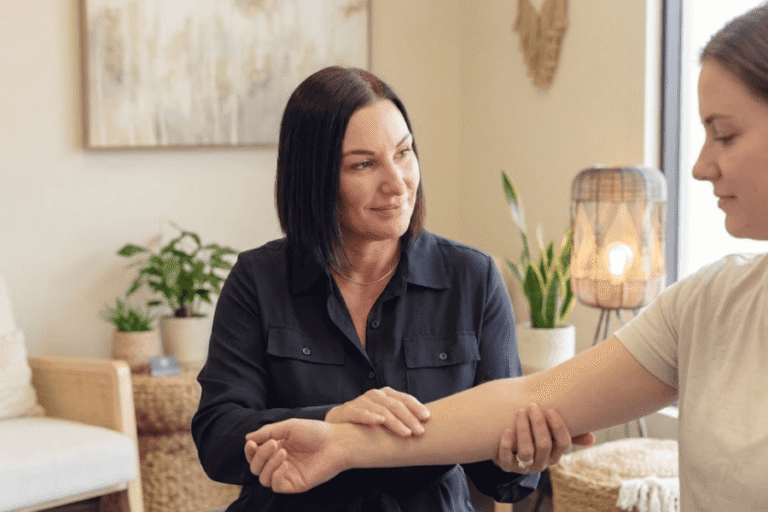
Muscle monitoring is not a test of how strong you are. Instead, it is a form of biofeedback.
A muscle may temporarily “unlock” when the nervous system is under stress. This doesn’t mean the muscle is weak. Rather, it indicates that communication between the brain, nervous system, muscles, and energy pathways may be disrupted.
These responses help guide where balancing techniques may be most beneficial during your session.
3. What Does "Energy" Mean in Touch for Health?
When we talk about energy in Touch for Health, we’re referring to the body’s communication systems.
This includes:
- The nervous system
- Circulation
- Lymphatic flow
- Connective tissue (fascia)
- Reflex pathways
- The body's electrical signalling
- Traditional acupuncture meridians
While every person’s experience is unique, many people report feeling calmer, clearer, more coordinated, and physically lighter following a balancing session.
Whether you think of this as improving energy flow or improving nervous system communication, the goal is the same: helping your body function more efficiently.
4. Why Do I Set a Goal Before the Session Begins?
Every Touch for Health session begins with your goal.
Your goal gives the balancing session direction and helps focus on the positive changes you’d like to experience. Examples include:
- I want to sleep better.
- I want more energy.
- I want to feel calmer.
- I want less neck tension.
- I want to feel more confident.
- I want to recover from stress.
Rather than treating a diagnosis, Touch for Health focuses on helping you move toward the outcome that matters most to you.
5. Why Do Emotions Sometimes Come Up During a Session?
The nervous system stores experiences from throughout our lives. Sometimes, as tension begins to release, thoughts, memories, or emotions naturally surface.
This isn’t because we’re trying to analyze your past.
Rather, your body may simply recognize an old stress pattern that is ready to let go.
You are always in control of the session, and we only explore what feels comfortable for you.
6. What Are Metaphors, and Why Are They Used?
This is one of the most unique aspects of Touch for Health.
Every muscle, meridian, and organ function has symbolic meanings called metaphors. These are not used to diagnose disease. Instead, they serve as gentle prompts that may help you view a situation from a different perspective.
For example, instead of asking:
“What’s wrong with you?”
A practitioner might ask:
“What are you carrying that no longer serves you?”
or
What are you trying to hold onto?”
Sometimes these questions create an “aha” moment. Sometimes they don’t, and that’s perfectly okay. The metaphor is simply an invitation, never a diagnosis.
7. Does This Mean My Organs Are Unhealthy?
No.
In Touch for Health, organ names are used symbolically. For example, the Liver Meridian is not evaluating your physical liver. Instead, it represents a broader pattern of function within the body’s energy system.
Likewise, a muscle associated with a particular meridian does not mean there is disease within that organ.
Touch for Health does not diagnose medical conditions. It simply identifies areas where balancing the body’s communication systems may help improve overall function.
8. How Is Touch for Health Different from Massage or Chiropractic Care?
Massage therapy primarily works with muscles and soft tissues.
Chiropractic care focuses on joint alignment and spinal mechanics.
Rather than replacing these therapies, Touch for Health can complement many conventional and natural approaches by focusing on how the body’s communication systems are working together.
Depending on your needs, a session may include:
- Neurolymphatic reflexes
- Neurovascular reflexes
- Spinal reflexes
- Acupressure
- Meridian balancing
- Emotional Stress Release
- Movement
- Breathing
- Visualization
- Sound
- Personalized goal work
9. Is Touch for Health Scientific?
Touch for Health draws from several fields, including applied kinesiology, anatomy, physiology, neuroscience, reflex physiology, stress physiology, Traditional Chinese Medicine, and educational kinesiology.
While research supports many individual concepts used within Touch for Health, such as touch, movement, and stress reduction, the complete Touch for Health system has not yet been validated through large clinical trials.
For this reason, Touch for Health is considered a complementary wellness approach and is not intended to replace medical care. Many people choose it because they appreciate its whole-person perspective and individualized approach.
10. Who Might Benefit from Touch for Health?
Touch for Health may benefit people who would like to improve:
- Stress resilience
- Posture
- Movement
- Coordination
- Flexibility
- Athletic performance
- Concentration
- Emotional well-being
- Recovery from everyday stress
- Overall balance
Because every session is individualized, no two appointments are exactly alike. Whether you’re looking to manage stress more effectively, improve your mobility, increase your energy, or simply feel more balanced, Touch for Health provides a personalized approach that works with your body rather than against it.
Ready to Experience Touch for Health?
If you’ve been wondering what Touch for Health is and whether it could be right for you, the next step is simply experiencing a session for yourself.
Every session is tailored to your individual goals and focuses on supporting your body’s natural ability to restore balance and resilience.
Whether you’re looking to reduce stress, improve your energy, move more comfortably, or simply feel more like yourself again, we’re here to help.
Ready to begin?
Learn what to expect during a Touch for Health Consultation or book your appointment today to discover how this gentle, whole-person approach can support your health and wellbeing.